It was 11:47 PM on a random Wednesday in late October, and I had one of those cravings that just wouldn’t quit. You know the feeling—when your brain decides it needs something warm, something creamy, something that tastes like fall in a bowl. I’d been scrolling through recipes all evening, bookmarking all these fancy butternut squash soups that called for things like leeks and crème fraîche and fresh thyme sprigs tied with kitchen twine. Let’s be real—I had none of that. What I did have was a sad-looking butternut squash sitting in my fruit bowl, a bunch of sage that was starting to wilt, and an idea that hit me while I was staring into the fridge, hoping something magical would appear.
I wasn’t about to drive to the store at midnight just for a soup craving. So I did what any reasonable person would do—I grabbed that squash, hacked it in half with my biggest knife (safety first, but also, desperation), and decided to roast it until it was so soft it basically surrendered. The sage went in with the squash, getting all crispy and fragrant, and honestly, the smell alone almost made up for the fact that I was making dinner at basically bedtime. I didn’t have heavy cream, but I had half-and-half from my morning coffee, and I figured, why not? It’s soup, not rocket science.
The first batch was a little too thin, and I may have added too much sage on accident. But the second batch—the one I’m sharing with you today—that was the one. It was creamy without being heavy, sweet from the roasted squash but balanced by that earthy sage, and it came together in a way that felt almost too easy for how good it tasted. I ate it at midnight standing in my kitchen, and I’m not ashamed to say I went back for seconds. This cozy creamy roasted butternut squash soup with sage has been my go-to ever since, and I think you’re going to love it just as much.
Why You’ll Love This Recipe
Honestly, I’ve tested this cozy creamy roasted butternut squash soup with sage about six times before I felt confident sharing it with you. I wanted it to be perfect—not in a fussy, complicated way, but in that simple, soul-satisfying way where every spoonful makes you close your eyes for a second. And let me tell you, this version nails it.
- Quick & Easy: From start to finish, this soup comes together in under an hour. Most of that time is hands-off roasting, so you can catch up on your favorite podcast or just sit down for a minute.
- Simple Ingredients: No fancy grocery trips needed. You probably already have the onion, garlic, and broth in your kitchen. The butternut squash and sage are the only special buys, and they’re everywhere this time of year.
- Perfect for Cozy Nights: This soup was made for those chilly evenings when all you want is something warm to hold in your hands. It’s also a lifesaver after a rough day—trust me, I’ve tested that theory.
- Crowd-Pleaser: I’ve served this at dinner parties and family gatherings, and it always gets rave reviews. Even my friend who claims she doesn’t like squash went back for thirds.
- Unbelievably Delicious: The secret here is roasting the squash with the sage and garlic before blending. It deepens the flavors in a way that stovetop methods just can’t match. The result is a soup that tastes like it simmered all day but actually took minimal effort.
What makes this recipe different from all the other butternut squash soups out there? It’s that roasted sage, honestly. Most recipes add sage at the end as a garnish, but roasting it alongside the squash infuses the entire soup with that earthy, slightly peppery flavor. Plus, the half-and-half gives you that creamy texture without making the soup feel heavy. It’s comfort food reimagined—healthier, faster, but with the same soul-soothing satisfaction.
What Ingredients You Will Need
This cozy creamy roasted butternut squash soup with sage uses simple, wholesome ingredients to deliver bold flavor and satisfying texture without any fuss. Most of these are pantry staples, especially if you cook fall recipes regularly. Here’s what you’ll need:
- 1 medium butternut squash (about 2-3 pounds / 900g-1.4 kg) – Look for one that feels heavy for its size and has a firm, unblemished skin. The neck should be thick and even for easier peeling. (If you’re short on time, pre-cut squash works fine, just adjust roasting time.)
- 2 tablespoons olive oil (30 ml) – A good quality extra virgin olive oil adds richness, but regular olive oil works too. I personally prefer California Olive Ranch for its balanced flavor.
- 1 medium yellow onion, chopped (about 1 cup / 150g) – Yellow onions have the right balance of sweetness and savory depth for this soup. White onions work in a pinch, but skip red onions—they’re too sharp.
- 3 cloves garlic, smashed – Smashing them instead of mincing means they roast more evenly and blend into the soup more smoothly. You can use garlic from a jar if that’s what you have, but fresh is better here.
- 10-12 fresh sage leaves (plus more for garnish) – Fresh sage is non-negotiable for this recipe. Dried sage just doesn’t have the same aromatic punch. If you grow sage in your garden, even better—the leaves are more tender and flavorful.
- 3 cups vegetable broth (720 ml) – I recommend using a low-sodium broth so you can control the salt level. Pacific Foods or Imagine brands work well. Chicken broth also works if you’re not vegetarian.
- 1/2 cup half-and-half (120 ml) – This gives the soup that velvety texture without being too heavy. You can substitute with heavy cream for a richer soup, or use full-fat coconut milk for a dairy-free version.
- 1/2 teaspoon salt (3g) – Start with this and adjust at the end. Different broths have different salt levels, so taste as you go.
- 1/4 teaspoon black pepper (1g) – Freshly ground is always better. It adds a subtle warmth that complements the sage beautifully.
- Pinch of nutmeg (optional, about 1/8 teaspoon) – This is my secret ingredient. It doesn’t scream “nutmeg” but it adds this subtle warmth that makes the soup taste extra cozy. Freshly grated is amazing, but pre-ground works too.
Substitution Guidance: If you’re dairy-free, swap the half-and-half with full-fat canned coconut milk or unsweetened oat milk. For a vegan version, use coconut milk and ensure your broth is vegetable-based. If you can’t find fresh sage, dried sage works but use only 1 teaspoon—it’s much more concentrated. And if butternut squash isn’t available, you can use a sugar pumpkin or kabocha squash, though the flavor will be slightly different.
Equipment Needed
You don’t need a lot of fancy equipment for this cozy creamy roasted butternut squash soup with sage, which is part of why I love it. Here’s what you’ll need:
- Large baking sheet (half-sheet pan, about 13×18 inches / 33×46 cm) – This gives the squash enough room to roast without steaming. If your pan is too small, the squash will cook unevenly. I use a Nordic Ware sheet pan and it’s perfect.
- Parchment paper or silicone baking mat – Not strictly necessary, but it makes cleanup so much easier. The caramelized squash can stick to the pan, and nobody wants to scrub that.
- Large pot or Dutch oven (5-6 quart / 5-6 liter capacity) – You’ll use this to sauté the onion and blend everything together. A Dutch oven is ideal because it holds heat well, but any heavy-bottomed pot works.
- Immersion blender – This is my preferred method because you can blend the soup right in the pot, which means less cleanup. If you don’t have one, a regular blender works fine—just be careful with hot liquids.
- Chef’s knife and cutting board – A sharp knife makes peeling and cutting the squash much safer and easier. Trust me, I learned this the hard way with a dull knife.
- Vegetable peeler – For peeling the squash. A Y-shaped peeler is easier to control than a straight one.
Budget-friendly tip: If you don’t have an immersion blender, let the soup cool slightly before transferring it to a regular blender in batches. Fill the blender no more than halfway, and hold the lid down with a towel while blending to prevent splatters. A food processor also works in a pinch, though the texture won’t be quite as smooth.
Preparation Method

Let me walk you through how to make this cozy creamy roasted butternut squash soup with sage. I’ve broken it down into clear steps so you can follow along easily.
- Preheat your oven to 400°F (200°C). While it’s heating up, line a large baking sheet with parchment paper or a silicone mat. This makes cleanup so much easier, and it prevents the squash from sticking.
- Prepare the butternut squash. Using a sharp chef’s knife, carefully cut off both ends of the squash. Then cut it in half where the narrow neck meets the round bulb. Use a vegetable peeler to remove the skin from both pieces. Cut the neck into 1-inch (2.5 cm) cubes. Cut the bulb in half, scoop out the seeds and stringy bits (save the seeds for roasting later if you want!), and cut the flesh into similar-sized cubes. Pro tip: If the squash is too hard to cut, microwave it whole for 2-3 minutes to soften it slightly. This makes peeling and cutting much easier.
- Roast the squash with sage and garlic. Place the cubed squash on the prepared baking sheet. Add the smashed garlic cloves and fresh sage leaves. Drizzle with 2 tablespoons of olive oil, then sprinkle with 1/4 teaspoon of salt and 1/8 teaspoon of black pepper. Toss everything together with your hands until the squash is evenly coated. Spread it in a single layer—don’t overcrowd the pan, or the squash will steam instead of roast. Roast for 30-35 minutes, flipping halfway through, until the squash is tender and caramelized around the edges. Your kitchen should smell amazing at this point.
- Sauté the onion. While the squash roasts, heat a drizzle of olive oil in your large pot or Dutch oven over medium heat. Add the chopped onion and cook for 5-7 minutes, stirring occasionally, until it’s soft and translucent. Don’t let it brown—you want it sweet, not caramelized. If the onion starts to stick, add a splash of water or broth.
- Combine and simmer. Once the squash is done roasting, add it to the pot with the onions. Include all those roasted sage leaves and garlic cloves—they’re packed with flavor. Pour in 3 cups of vegetable broth. Bring the mixture to a gentle boil, then reduce the heat to low and let it simmer for 10 minutes. This allows all the flavors to meld together. At this point, the soup should look quite brothy and not at all creamy—that’s normal.
- Blend until smooth. Remove the pot from the heat. Using an immersion blender, blend the soup directly in the pot until it’s completely smooth and velvety. If you’re using a regular blender, let the soup cool for 5 minutes first, then transfer it in batches (fill no more than halfway) and blend until smooth. Be careful with hot liquids—they expand in the blender and can cause the lid to pop off. Always hold the lid down with a folded kitchen towel.
- Add the cream and seasonings. Return the blended soup to the pot (if you used a regular blender). Stir in 1/2 cup of half-and-half, the remaining 1/4 teaspoon of salt, the remaining 1/8 teaspoon of pepper, and the pinch of nutmeg. Heat the soup over low heat for 3-5 minutes, stirring occasionally, until it’s warmed through. Don’t let it boil after adding the cream, or it might curdle.
- Taste and adjust. This is the most important step. Taste your soup and adjust the seasonings. Does it need more salt? A bit more pepper? Maybe an extra splash of half-and-half if you want it creamier? Trust your taste buds here. I usually end up adding another pinch of salt and a bit more nutmeg.
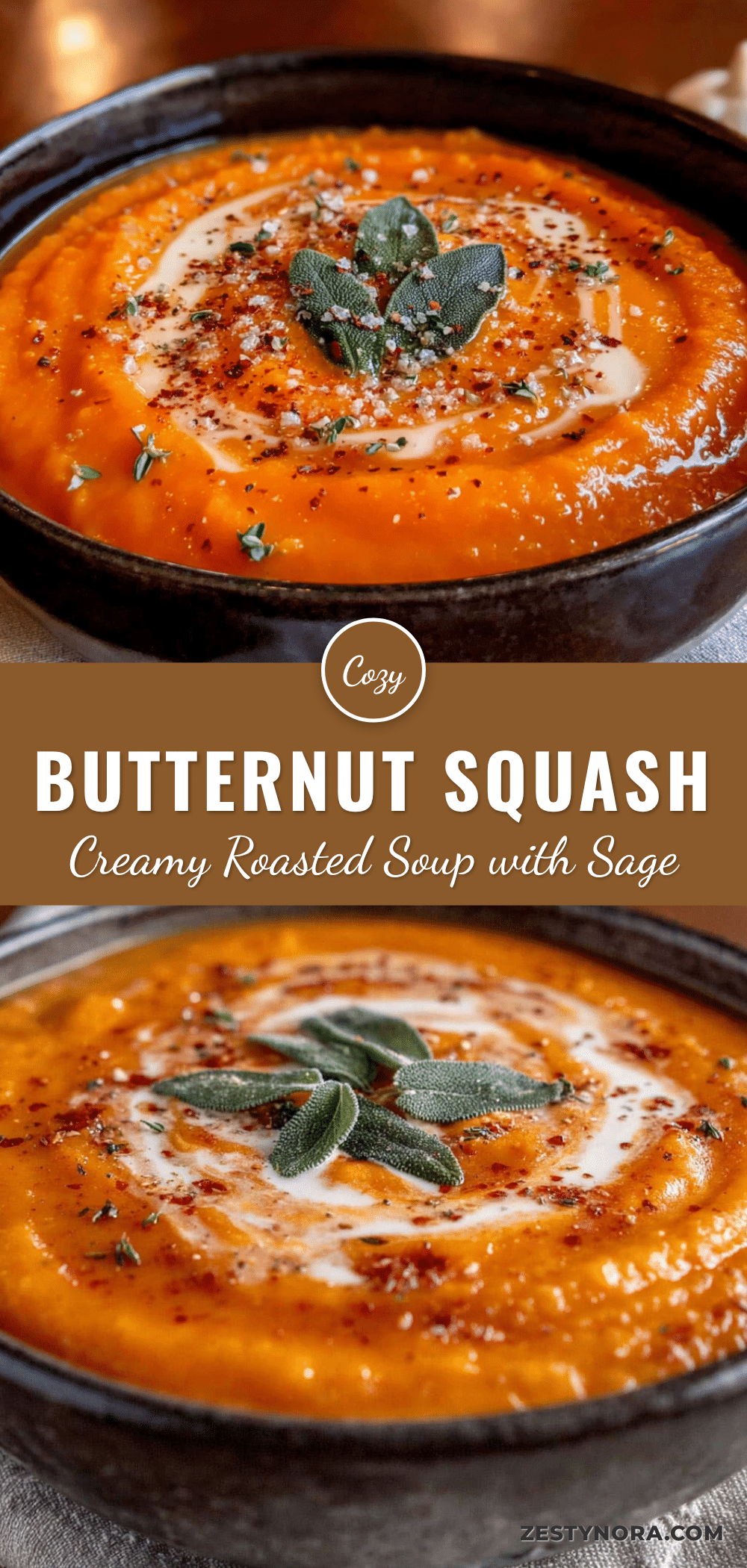
- Serve immediately. Ladle the soup into bowls and garnish with a few fresh sage leaves, a drizzle of cream or coconut milk, and a crack of black pepper. If you saved the squash seeds, toast them in a dry pan for 3-4 minutes and sprinkle them on top for a nice crunch.
Cooking Tips & Techniques
After making this cozy creamy roasted butternut squash soup with sage more times than I can count, I’ve picked up a few tricks that make a real difference. Let me share them with you.
Don’t skip the roasting step. I know it’s tempting to just boil the squash to save time, but roasting is what gives this soup its deep, caramelized flavor. The high heat concentrates the squash’s natural sugars and adds a subtle smokiness that you just can’t get from boiling. Plus, roasting the sage alongside the squash infuses the leaves and makes them crispy—they blend into the soup beautifully.
Cut the squash into even pieces. This is one of those things that seems minor but really matters. If your cubes are different sizes, some will overcook while others stay underdone. Aim for 1-inch (2.5 cm) cubes, and try to keep them uniform. Your future self will thank you when the soup blends smoothly.
Watch your blending technique. I learned this one the hard way. If you’re using an immersion blender, keep it fully submerged while it’s running to avoid splattering hot soup everywhere. Move it in gentle circles and up-and-down motions until the soup is smooth. If you’re using a regular blender, always let the soup cool for at least 5 minutes first, and never fill the blender more than halfway. Hot liquid expands, and you don’t want a soup explosion in your kitchen.
Season in layers. This is a professional technique that home cooks often overlook. I add salt and pepper at three different stages—once before roasting, once when simmering, and once at the end after blending. This builds complexity and ensures the seasoning is evenly distributed. Trust me, it makes a difference.
Make it ahead for better flavor. Like many soups, this one actually tastes better the next day. The flavors have time to meld and deepen overnight. If you can, make it a day ahead and reheat it gently. Just don’t add the cream until you’re ready to serve, or the texture might change upon reheating.
My biggest failure: The first time I made this, I added all the sage at the end as a garnish and wondered why the soup tasted flat. Roasting the sage is non-negotiable—it transforms the flavor completely. Learn from my mistake.
Variations & Adaptations
One of the best things about this cozy creamy roasted butternut squash soup with sage is how adaptable it is. Here are some variations I’ve tried and loved:
- Vegan Version: Swap the half-and-half with full-fat canned coconut milk. The coconut flavor is subtle and actually complements the sage beautifully. Use vegetable broth and you’re good to go. I’ve made this for vegan friends and they couldn’t tell the difference.
- Spicy Twist: Add 1/2 teaspoon of red pepper flakes or a chopped chipotle pepper in adobo sauce when you sauté the onion. The heat cuts through the creaminess and adds a nice kick. I tried this on a whim one night and it’s become my second-favorite version.
- Apple-Squash Combo: Roast one peeled and chopped apple (Honeycrisp or Fuji work great) alongside the squash. The apple adds natural sweetness and a subtle fruity note that pairs beautifully with the sage. This is perfect for fall gatherings.
- Thicker Soup: If you prefer a heartier soup, add a peeled and cubed potato to the roasting pan. The potato will break down during blending and make the soup extra thick and creamy without adding more cream.
- Instant Pot Method: Sauté the onion using the sauté function, then add all the roasted ingredients and broth. Pressure cook on high for 10 minutes, then natural release for 5 minutes. Blend and add the cream. This cuts the total time down to about 30 minutes.
Dietary Adaptations: For a gluten-free version, this soup is naturally gluten-free as written. For a nut-free version, skip any nut-based milk alternatives and stick with oat milk or coconut milk. If you’re watching your sodium, use unsalted broth and adjust the salt at the end.
Serving & Storage Suggestions
This cozy creamy roasted butternut squash soup with sage is best served hot, but not boiling. I like to let it sit for 2-3 minutes after ladling to let the flavors settle. For presentation, I drizzle a little extra cream or coconut milk on top in a swirl pattern, then add a few fresh sage leaves and a crack of black pepper. If you’re feeling fancy, a sprinkle of toasted pumpkin seeds or roasted squash seeds adds a lovely crunch.
What to serve with it: This soup pairs beautifully with crusty bread for dipping—a sourdough boule or a warm baguette is perfect. For a more substantial meal, serve it alongside a grilled cheese sandwich (try it with sharp cheddar and apple slices) or a simple green salad with a tangy vinaigrette. I also love it with a side of roasted Brussels sprouts for a complete fall dinner.
Storage Instructions: Store leftover soup in an airtight container in the refrigerator for up to 5 days. The flavors actually deepen and get better after a day or two. For longer storage, freeze the soup (without the cream) in freezer-safe containers for up to 3 months. When you’re ready to eat it, thaw overnight in the refrigerator, then reheat gently on the stovetop, adding the cream once it’s warm.
Reheating Tips: Reheat the soup over medium-low heat, stirring occasionally. If it seems too thick after refrigeration, add a splash of broth or water to thin it out. Avoid boiling, especially if the cream has already been added, as it can cause the soup to separate. Microwave reheating works too—just do it in 30-second bursts, stirring between each, until hot.
Flavor Development: I’ve noticed that this soup is at its best on day two. The sage flavor mellows and integrates more fully, and the sweetness of the squash becomes more pronounced. It’s one of those rare recipes that’s actually better as leftovers.
Nutritional Information & Benefits
This cozy creamy roasted butternut squash soup with sage isn’t just delicious—it’s also packed with nutrients. Here’s a rough estimate per serving (based on 6 servings):
- Calories: Approximately 180-200 per serving
- Protein: 4g
- Fat: 8g (mostly from olive oil and half-and-half)
- Carbohydrates: 28g
- Fiber: 5g
- Sugar: 8g (natural sugars from the squash)
- Vitamin A: Over 200% of the daily recommended intake (from the butternut squash)
- Vitamin C: About 30% of the daily recommended intake
- Potassium: 600mg
Health Benefits: Butternut squash is an excellent source of vitamin A, which supports eye health and immune function. It’s also rich in antioxidants like beta-carotene, which can help reduce inflammation. The sage in this recipe isn’t just for flavor—it has anti-inflammatory properties and is traditionally used to support digestion. The olive oil provides healthy monounsaturated fats that are good for heart health.
Dietary Considerations: This soup is naturally gluten-free and can easily be made vegan by swapping the half-and-half with coconut milk. It’s also relatively low in calories for such a satisfying dish, making it a great option if you’re watching your weight. The main allergen to note is dairy (from the half-and-half), but as mentioned, it’s easy to substitute.
My Personal Take: I love that this soup feels indulgent but is actually quite healthy. It’s the kind of meal that nourishes you from the inside out—warm, comforting, and full of good-for-you ingredients. I don’t stress about the half-and-half because a little bit goes a long way in making the soup feel luxurious.
Conclusion
Honestly, I think this cozy creamy roasted butternut squash soup with sage has earned a permanent spot in my fall recipe rotation. It’s everything I want from a comfort food—warm, creamy, deeply flavorful, and made with simple ingredients that I usually have on hand. The best part? It comes together in under an hour with minimal fuss, but tastes like you spent all day tending to it.
I hope you give this recipe a try and make it your own. Maybe you’ll add a pinch of cayenne for heat, or swap the sage for rosemary, or serve it with a giant pile of croutons on top. That’s the beauty of soup—it’s forgiving and adaptable. Don’t be afraid to experiment and see what works for you.
If you do make this soup, I’d love to hear about it! Drop a comment below and let me know how it turned out, or share your own twist on the recipe. And if you’re looking for more cozy fall recipes, be sure to check out my creamy Tuscan chicken soup and garlic herb roasted vegetables—they’re perfect companions for this soup. Until next time, happy cooking, and may your kitchen always smell like roasted sage.
Frequently Asked Questions
Can I use frozen butternut squash for this soup?
Yes, you can use frozen butternut squash in a pinch. However, you’ll need to adjust the roasting time since frozen squash releases more water. Roast it at 400°F (200°C) for about 40-45 minutes, and don’t worry if it doesn’t caramelize as much as fresh squash. The soup will still be delicious, just slightly less sweet.
How can I make this soup thicker?
If you prefer a thicker soup, try adding a peeled and cubed potato to the roasting pan with the squash. The potato will break down during blending and act as a natural thickener. Alternatively, you can reduce the amount of broth to 2 1/2 cups instead of 3, or let the soup simmer for an extra 10 minutes after blending to evaporate some of the liquid.
Can I make this soup without an immersion blender?
Absolutely! If you don’t have an immersion blender, let the soup cool for 5-10 minutes, then transfer it to a regular blender in batches. Fill the blender no more than halfway, hold the lid down with a folded kitchen towel, and blend until smooth. A food processor also works, though the texture might be slightly less silky.
Is this soup freezer-friendly?
Yes, this soup freezes beautifully! For best results, freeze it before adding the half-and-half. Let the soup cool completely, then transfer it to freezer-safe containers or zip-top bags. It will keep for up to 3 months. When you’re ready to eat, thaw overnight in the refrigerator, reheat gently, and stir in the cream at the end.
What can I use instead of sage?
If you don’t have fresh sage, you can use 1 teaspoon of dried sage instead—just add it to the pot when you sauté the onion so it can rehydrate. Rosemary is also a wonderful substitute; use 2-3 fresh sprigs and roast them with the squash, then remove the woody stems before blending. Thyme works well too, though the flavor will be more subtle.
Pin This Recipe!
Cozy Creamy Roasted Butternut Squash Soup with Sage – Best Easy Recipe

This creamy roasted butternut squash soup with sage is the ultimate fall comfort food. Made with simple ingredients and roasted to deepen the flavors, it’s ready in under an hour and perfect for cozy nights.
- Prep Time: 15 minutes
- Cook Time: 35 minutes
- Total Time: 50 minutes
- Yield: 6 servings 1x
- Category: Soup
- Cuisine: American
Ingredients
- 1 medium butternut squash (about 2–3 pounds / 900g-1.4 kg)
- 2 tablespoons olive oil (30 ml)
- 1 medium yellow onion, chopped (about 1 cup / 150g)
- 3 cloves garlic, smashed
- 10–12 fresh sage leaves (plus more for garnish)
- 3 cups vegetable broth (720 ml)
- 1/2 cup half-and-half (120 ml)
- 1/2 teaspoon salt (3g)
- 1/4 teaspoon black pepper (1g)
- Pinch of nutmeg (optional, about 1/8 teaspoon)
Instructions
- Preheat your oven to 400°F (200°C). Line a large baking sheet with parchment paper or a silicone mat.
- Prepare the butternut squash: cut off both ends, cut in half where the narrow neck meets the round bulb, peel with a vegetable peeler, cut neck into 1-inch cubes, cut bulb in half, scoop out seeds, and cut flesh into similar-sized cubes.
- Place cubed squash on the prepared baking sheet. Add smashed garlic cloves and fresh sage leaves. Drizzle with 2 tablespoons olive oil, sprinkle with 1/4 teaspoon salt and 1/8 teaspoon black pepper. Toss to coat evenly. Spread in a single layer. Roast for 30-35 minutes, flipping halfway, until tender and caramelized.
- While squash roasts, heat a drizzle of olive oil in a large pot or Dutch oven over medium heat. Add chopped onion and cook for 5-7 minutes, stirring occasionally, until soft and translucent.
- Once squash is done, add it to the pot with the onions, including all roasted sage leaves and garlic cloves. Pour in 3 cups vegetable broth. Bring to a gentle boil, then reduce heat to low and simmer for 10 minutes.
- Remove pot from heat. Using an immersion blender, blend the soup directly in the pot until completely smooth. If using a regular blender, let cool for 5 minutes, then blend in batches (fill no more than halfway).
- Return blended soup to the pot. Stir in 1/2 cup half-and-half, remaining 1/4 teaspoon salt, remaining 1/8 teaspoon pepper, and pinch of nutmeg. Heat over low heat for 3-5 minutes, stirring occasionally, until warmed through. Do not boil.
- Taste and adjust seasonings as needed.
- Serve immediately, garnished with fresh sage leaves, a drizzle of cream or coconut milk, and a crack of black pepper.
Notes
For a vegan version, swap half-and-half with full-fat canned coconut milk. For a thicker soup, add a peeled and cubed potato to the roasting pan. The soup tastes even better the next day. Freeze without cream for up to 3 months.
Nutrition
- Serving Size: 1 serving (about 1.5
- Calories: 190
- Sugar: 8
- Sodium: 480
- Fat: 8
- Saturated Fat: 2
- Carbohydrates: 28
- Fiber: 5
- Protein: 4
Keywords: butternut squash soup, roasted butternut squash soup, creamy squash soup, sage soup, fall soup, easy soup recipe