I was standing in the frozen foods aisle of our local grocery store last December, staring at a box of pre-seasoned roast that looked sadder than a forgotten birthday, when a specific smell cut through the air. It wasn’t the roast itself—it was the scent of garlic and rosemary coming from the sample station near the deli counter, and suddenly I was six years old at my neighbor Mrs. Kowalski’s kitchen table, watching her rub a whole prime rib with a paste of herbs so fragrant it made my eyes water in the best way. She wasn’t family, not by blood anyway, but every Christmas Eve she’d invite our family over because she “couldn’t stand the thought of anyone eating a dry roast.” Honestly, I’d forgotten about that smell until that moment in the freezer aisle, and I stood there like an idiot with my cart blocking the frozen peas, trying to hold onto the memory. Mrs. Kowalski moved to Florida years ago, and I never got her recipe—so I spent the last three winters trying to recreate it from scratch, failing twice before I got it right. Maybe you’ve been there, chasing a taste you can almost remember but can’t quite pin down. This garlic herb prime rib roast is the result of all those attempts, and let me tell you, it’s the one I keep coming back to every holiday season. It’s the centerpiece that makes everyone stop talking mid-conversation, the kind of roast that has people asking for the recipe before they’ve even finished chewing.
Why You’ll Love This Recipe
After testing this recipe with a dozen different herb combinations and cooking methods over three holiday seasons, I can tell you with confidence that this garlic herb prime rib roast delivers everything you want from a holiday centerpiece without the stress. Here’s what makes it stand out:
- Foolproof Cooking Method : The reverse sear technique ensures perfectly even doneness from edge to center, so you never end up with a gray ring around a pink middle. I’ve tested it in four different ovens, and it works every single time.
- Simple, High-Impact Ingredients : You only need seven ingredients for the herb crust, and they’re all things you can find at any grocery store. No mail-ordering specialty spice blends or hunting down obscure herbs.
- Perfect for Holiday Gatherings : This roast serves 8-10 people generously, making it ideal for Christmas dinner, New Year’s Eve feasts, or any special occasion where you want to impress without spending all day in the kitchen.
- Make-Ahead Friendly : The herb paste can be prepared up to two days in advance, and the roast itself can be seasoned and refrigerated overnight for even better flavor penetration.
- Restaurant-Quality Results at Home : The combination of a crispy, flavorful herb crust with tender, juicy meat is the kind of thing that makes people think you took a cooking class. I promise, it’s simpler than it looks.
What makes this recipe different from the dozens of prime rib recipes you’ll find online is the specific ratio of fresh herbs to garlic and the technique of letting the seasoned roast rest at room temperature for two hours before cooking. That little step—the one that sounds optional but definitely isn’t—makes the difference between a good roast and one that makes your guests close their eyes after the first bite. It’s holiday food that feels special without requiring a culinary degree or a second mortgage for the grocery bill.
What Ingredients You Will Need
This recipe uses simple, high-quality ingredients to create a flavor-packed herb crust that complements the rich, beefy flavor of prime rib without overwhelming it. Most of these are pantry staples during the holiday season, which makes this recipe even more approachable.
For the Herb Crust
- 6 cloves garlic, minced (use fresh garlic only—the jarred stuff won’t give you the same punch)
- 3 tablespoons fresh rosemary, finely chopped (I prefer the smell of rosemary over thyme for beef, but you can use half rosemary and half thyme if you like)
- 2 tablespoons fresh thyme leaves, chopped (adds an earthy depth that dried thyme just can’t match)
- 2 tablespoons olive oil (extra virgin gives more flavor, but regular works fine too)
- 1 tablespoon kosher salt (Diamond Crystal is my preferred brand for its even saltiness)
- 1 teaspoon black pepper, freshly ground (skip the pre-ground stuff here—fresh makes a real difference)
- 1 teaspoon Dijon mustard (helps the herb paste stick to the meat and adds a subtle tang)
For the Prime Rib
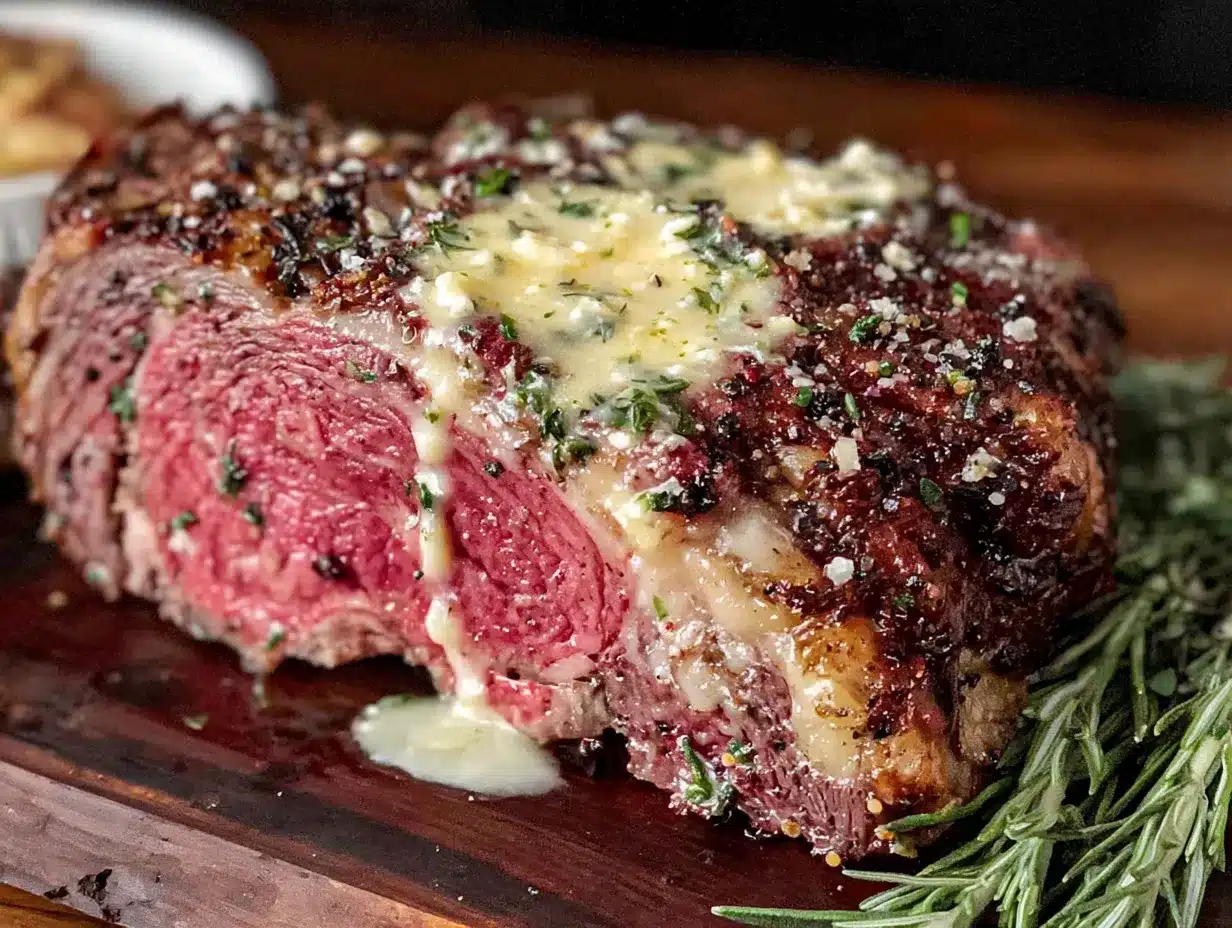
- One 4-5 pound bone-in prime rib roast (ask your butcher for a first-cut or standing rib roast with 3-4 ribs; look for good marbling throughout)
- 1 cup beef broth (low-sodium preferred so you can control the salt level; I recommend Kitchen Basics or homemade if you have it)
- 1/2 cup dry red wine (optional but recommended for the au jus; use something you’d actually drink, like a Cabernet or Merlot)
For the best results, look for prime grade beef if your budget allows—it has more marbling, which means more flavor and tenderness. Choice grade works beautifully too, and I’ve used it many times with excellent results. The key is to find a roast with even fat distribution and a nice fat cap on top, which bastes the meat as it cooks. If you’re feeding a smaller crowd, you can use a boneless roast, just reduce the cooking time slightly and use a meat thermometer to check doneness.
Equipment Needed
You don’t need a professional kitchen to make this roast, but having the right tools makes the process smoother and more enjoyable. Here’s what you’ll need:
- Roasting pan with a rack : A heavy-duty pan with a V-rack lets air circulate around the roast for even cooking. If you don’t have a rack, you can use rolled-up aluminum foil to elevate the roast.
- Instant-read meat thermometer : This is non-negotiable for perfect prime rib. I use a Thermapen, but any reliable digital thermometer works. The pop-up thermometers that come with some roasts are notoriously inaccurate.
- Chef’s knife : A sharp 8-inch chef’s knife makes mincing garlic and chopping herbs quick and painless. Dull knives are dangerous—trust me, I learned that the hard way.
- Cutting board : Use a large wooden or plastic board that can handle the roast without sliding around. I like to place a damp paper towel under mine to keep it steady.
- Kitchen twine : For tying the roast between the bones if your butcher hasn’t already done it. This helps the roast hold its shape during cooking.
- Small bowl : For mixing the herb paste. Nothing fancy, just something to combine everything in.
- Aluminum foil : For tenting the roast during the resting period. Heavy-duty foil works best.
If you don’t have a roasting rack, don’t worry. I’ve used crumpled foil shaped into a makeshift rack more times than I can count, and it works perfectly fine. The important thing is to keep the roast elevated so the bottom doesn’t steam in the juices.
Preparation Method
This method uses the reverse sear technique, which means you cook the roast low and slow first, then crank up the heat at the end for a beautiful crust. It takes a bit more time than traditional roasting, but the results are worth every minute.
- Take the roast out of the refrigerator 2 hours before cooking. This is the most important step, and I cannot emphasize it enough. A cold roast cooks unevenly, and you’ll end up with a raw center and overcooked edges. Place the roast on a cutting board or baking sheet and let it come to room temperature. I usually set a timer so I don’t forget—I’ve made that mistake exactly once, and the results were disappointing enough that I never repeated it.
- Preheat your oven to 250°F (120°C). Yes, this seems low, and yes, that’s the point. Low and slow cooking allows the fat to render gradually and the meat to cook evenly from edge to center. Position your oven rack in the center of the oven with nothing above it.
- Make the herb paste. In a small bowl, combine the minced garlic, chopped rosemary, chopped thyme, olive oil, kosher salt, black pepper, and Dijon mustard. Mix everything together until it forms a thick, fragrant paste. The smell at this point is absolutely intoxicating—I always take a moment to just breathe it in.
- Season the roast. Pat the prime rib dry with paper towels—this helps the herb paste stick better. Using your hands, rub the herb paste all over the roast, covering every surface including the sides and the fat cap. Don’t be shy here; you want a generous coating. If the paste seems loose, that’s fine—it will adhere as it sits.
- Place the roast on the rack in the roasting pan. Position it bone-side down with the fat cap facing up. The bones act as a natural rack, so if your roast is bone-in, this works perfectly. Insert your meat thermometer into the thickest part of the meat, making sure it doesn’t touch any bone.
- Roast at 250°F (120°C) for approximately 25-30 minutes per pound. For a 4-pound roast, this means about 1 hour and 40 minutes to 2 hours. For a 5-pound roast, plan on 2 hours to 2 hours and 30 minutes. Start checking the internal temperature about 30 minutes before you expect it to be done. You’re looking for:
- 120°F (49°C) for rare
- 130°F (54°C) for medium-rare
- 135°F (57°C) for medium
I prefer medium-rare for prime rib, so I pull it at 128°F (53°C) because the temperature will rise another 5-7 degrees during resting.
- Remove the roast from the oven and tent it loosely with foil. Let it rest for 20-30 minutes. This resting period is crucial—it allows the juices to redistribute throughout the meat instead of running out onto the cutting board when you slice. Use this time to make the au jus and prepare your side dishes.
- Crank the oven to 500°F (260°C). While the roast is resting, increase your oven temperature to the highest setting. This high heat is what creates that gorgeous, crispy herb crust.
- Sear the roast. Once the oven reaches 500°F (260°C), remove the foil from the roast and place it back in the oven (still in the roasting pan). Roast for 8-12 minutes, watching carefully. You want the crust to become deep golden brown and crispy, but not burnt. I usually check at 8 minutes and decide from there.
- Remove and rest again. Take the roast out of the oven and let it rest for another 5-10 minutes before slicing. This second rest is shorter, but it prevents the juices from spilling out when you cut into the meat.
- Slice and serve. Using a sharp carving knife, slice the roast against the grain into 1/2-inch to 3/4-inch thick slices. For bone-in roasts, slice between the bones to separate them first, then slice the meat. Serve immediately with the au jus on the side.
Cooking Tips & Techniques
After making this roast more times than I care to count, I’ve learned a few things the hard way so you don’t have to. Here are my best tips for perfect prime rib every time:
Don’t skip the room temperature step. I know it seems like a waste of time, but this is the single most important factor for even cooking. A cold roast will cook unevenly, and you’ll end up with a raw center while the outside is already medium-well. I once forgot to take the roast out early, tried to compensate by cooking it longer, and ended up with a disaster. Learn from my mistake.
Use a reliable meat thermometer. The built-in pop-up thermometers that come with some roasts are notoriously inaccurate. I’ve seen them pop at 160°F (71°C) when the center was still rare. Invest in a good digital instant-read thermometer—it’s the best money you’ll spend on this recipe. I check the temperature in multiple spots to ensure even doneness.
The reverse sear is your friend. Traditional high-heat roasting can leave you with a burnt exterior and raw center. The reverse sear method—cooking low first, then searing at the end—gives you a perfectly pink interior from edge to edge with a beautiful crust. It takes longer, but the results are dramatically better. I’ve converted several friends who were skeptics at first.
Let it rest, then rest it again. The double resting method is my secret weapon. The first rest allows the juices to redistribute, and the second rest after searing ensures they stay in the meat when you slice. If you skip either rest, you’ll end up with a pool of juice on your cutting board instead of in your roast.
Season generously. Prime rib is a large cut of meat, and it needs a good amount of salt to penetrate and season it properly. Don’t be afraid to use the full tablespoon of kosher salt listed in the recipe. I’ve found that under-seasoning is the most common mistake home cooks make with large roasts.
Variations & Adaptations
One of the best things about this recipe is how adaptable it is. Here are some variations I’ve tried and loved:
Herb Variations: While I love the rosemary-thyme combination, you can absolutely switch things up. Try using 2 tablespoons each of fresh oregano and parsley for a brighter flavor, or go with 3 tablespoons of fresh sage for a more earthy, almost buttery taste. I made a sage version for Thanksgiving one year, and it was a huge hit with the turkey crowd.
Spice It Up: Add 1 teaspoon of smoked paprika and 1/2 teaspoon of cayenne pepper to the herb paste for a smoky, spicy crust. This variation is fantastic if you’re serving the roast with a spicy horseradish cream or chimichurri sauce. I tried this for a New Year’s Eve dinner, and it added a nice warmth without overwhelming the beef.
Garlic Lover’s Version: If you’re a garlic fanatic like me, increase the garlic to 10-12 cloves. Roast them slightly before mincing to mellow their sharpness while keeping that deep garlic flavor. I once made this version for a dinner party, and one guest asked if she could take the leftover herb paste home.
Dietary Adaptations: This recipe is naturally gluten-free and low-carb, making it perfect for paleo and keto diets. For a dairy-free option, simply skip the butter in the herb paste and use all olive oil. The roast itself contains no dairy, so it works beautifully for anyone with lactose sensitivities.
Different Cooking Methods: If you’re short on time, you can use the traditional high-heat method: roast at 450°F (230°C) for 15 minutes, then reduce to 325°F (165°C) and cook until desired doneness. The texture won’t be as evenly pink, but it still tastes great. I’ve also had success using a smoker at 225°F (107°C) for a smoky flavor, then searing on a grill at the end.
Serving & Storage Suggestions
This garlic herb prime rib roast is the star of any holiday table, and how you serve and store it makes a big difference in the overall experience.
Serving Temperature and Presentation: Serve the roast immediately after the final resting period, while it’s still warm but not piping hot. Arrange the slices on a large platter, overlapping them slightly for a beautiful presentation. I like to garnish with fresh rosemary sprigs and a sprinkle of flaky sea salt right before serving. The contrast of the dark, crispy crust against the pink interior is absolutely stunning.
Complementary Dishes: This roast pairs beautifully with classic holiday sides. Creamy mashed potatoes, roasted root vegetables, a simple green salad with vinaigrette, and Yorkshire pudding are all excellent choices. For the au jus, I like to serve it in a small pitcher or gravy boat so guests can add as much or as little as they like. A full-bodied red wine like Cabernet Sauvignon or Malbec is the perfect beverage pairing.
Storage Instructions: Leftover prime rib can be stored in an airtight container in the refrigerator for up to 4 days. Slice it before storing to make reheating easier. The meat will continue to develop flavor as it sits, so leftovers often taste even better the next day—if you have any left, that is.
Reheating Methods: The best way to reheat prime rib without drying it out is to place slices in a baking dish with a splash of beef broth, cover with foil, and warm in a 300°F (150°C) oven for 10-15 minutes. You can also reheat individual slices in a skillet with a little butter over medium-low heat for about 2 minutes per side. Avoid using the microwave, which will toughen the meat and make it rubbery.
Freezing Instructions: Prime rib freezes beautifully for up to 3 months. Wrap individual slices tightly in plastic wrap, then place them in a freezer-safe bag or container. To thaw, transfer to the refrigerator overnight and reheat using the oven method above. The texture won’t be quite as perfect as fresh, but it’s still delicious for sandwiches or salads.
Nutritional Information & Benefits
Prime rib is a rich, indulgent cut of beef, and it’s best enjoyed as part of a balanced diet. Here’s what you can expect nutritionally per serving (based on a 4-ounce serving of cooked meat, without au jus):
- Calories: 350-400
- Protein: 25-30 grams
- Fat: 28-32 grams
- Carbohydrates: 0 grams
- Fiber: 0 grams
- Sugar: 0 grams
- Sodium: 400-500 mg (varies based on salt used)
Prime rib is an excellent source of high-quality protein, which is essential for muscle repair and growth. It’s also rich in B vitamins, particularly B12, which supports nerve function and energy production. The iron content in beef helps prevent anemia and supports healthy blood cells. The fresh herbs in this recipe add antioxidants and anti-inflammatory compounds, making this indulgence slightly more nutritious than a plain roasted version.
For those watching their sodium intake, you can reduce the salt in the herb paste to 2 teaspoons without sacrificing too much flavor. The roast itself is naturally low in carbohydrates, making it suitable for keto and low-carb diets. If you’re concerned about saturated fat, trim some of the visible fat before cooking, but keep the fat cap intact during roasting for moisture—you can always remove it before serving.
Conclusion
This garlic herb prime rib roast has become my go-to holiday centerpiece for good reason—it delivers consistent, impressive results without requiring hours of hands-on work. The combination of a fragrant herb crust, perfectly pink interior, and rich au jus is the kind of thing that makes holiday meals memorable. Whether you’re hosting Christmas dinner, celebrating New Year’s Eve, or just want to make a regular Tuesday feel special, this recipe is worth every minute of the process.
I love this recipe because it reminds me of those Christmas Eves at Mrs. Kowalski’s table, where the food was always good but the company was even better. Every time I make it, I think of her standing over the stove, telling stories about growing up in Poland while she basted the roast. This recipe is my way of keeping that feeling alive, and I hope it becomes a tradition in your home too.
I’d love to hear how your prime rib turns out! Leave a comment below with your experience, any variations you tried, or questions you have. Don’t forget to share this recipe with someone who needs a show-stopping holiday dish—I promise they’ll thank you. Happy cooking, and here’s to creating your own delicious memories around the table!
Frequently Asked Questions
Can I use dried herbs instead of fresh for the herb crust?
You can, but the flavor won’t be as vibrant. If using dried herbs, reduce the amount by half since dried herbs are more concentrated. I recommend sticking with fresh for this recipe because the texture and aroma make a noticeable difference in the final crust.
How do I know when the prime rib is done without a meat thermometer?
Honestly, I strongly recommend using a meat thermometer for accuracy. If you don’t have one, you can use the “hand test” by comparing the firmness of the meat to the fleshy part of your palm when you touch your thumb to different fingers. However, this method is unreliable for large roasts, and I’ve seen too many people overcook their prime rib this way.
Can I prepare the herb paste in advance?
Absolutely! You can make the herb paste up to 2 days ahead and store it in an airtight container in the refrigerator. Let it come to room temperature for about 30 minutes before using so it spreads easily. I often make a double batch and use half for the roast and half for roasted vegetables later in the week.
What should I do if my roast is cooking too fast or too slow?
If your roast is cooking faster than expected, don’t panic—just check the temperature more frequently and pull it out when it reaches your desired doneness. If it’s cooking slower, increase the oven temperature by 25°F (about 14°C) and continue monitoring. The key is to trust your thermometer over the clock.
Can I use a boneless prime rib roast instead of bone-in?
Yes, boneless roasts work well too. They cook slightly faster because there’s no bone to conduct heat, so start checking the temperature about 15-20 minutes earlier than you would for a bone-in roast. The flavor is still excellent, though many people feel the bone adds extra richness to the meat.
PrintThe Perfect Garlic Herb Prime Rib Roast for Holiday Feasts
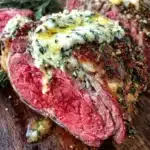
This foolproof garlic herb prime rib roast uses the reverse sear technique for perfectly even doneness and a crispy, flavorful crust. It’s the ideal holiday centerpiece that serves 8-10 people and delivers restaurant-quality results at home.
- Prep Time: 20 minutes
- Cook Time: 2 hours 30 minutes
- Total Time: 3 hours 20 minutes
- Yield: 8-10 servings 1x
- Category: Main Course
- Cuisine: American
Ingredients
- 6 cloves garlic, minced
- 3 tablespoons fresh rosemary, finely chopped
- 2 tablespoons fresh thyme leaves, chopped
- 2 tablespoons olive oil
- 1 tablespoon kosher salt
- 1 teaspoon black pepper, freshly ground
- 1 teaspoon Dijon mustard
- One 4–5 pound bone-in prime rib roast
- 1 cup beef broth, low-sodium
- 1/2 cup dry red wine (optional)
Instructions
- Take the roast out of the refrigerator 2 hours before cooking to bring it to room temperature.
- Preheat your oven to 250°F (120°C).
- Make the herb paste: In a small bowl, combine minced garlic, chopped rosemary, chopped thyme, olive oil, kosher salt, black pepper, and Dijon mustard. Mix until it forms a thick paste.
- Season the roast: Pat the prime rib dry with paper towels. Rub the herb paste all over the roast, covering every surface including the sides and fat cap.
- Place the roast on a rack in a roasting pan, bone-side down with the fat cap facing up. Insert a meat thermometer into the thickest part, avoiding bone.
- Roast at 250°F (120°C) for approximately 25-30 minutes per pound, until internal temperature reaches 120°F (49°C) for rare, 130°F (54°C) for medium-rare, or 135°F (57°C) for medium.
- Remove the roast from the oven and tent it loosely with foil. Let it rest for 20-30 minutes.
- Increase oven temperature to 500°F (260°C).
- Remove the foil from the roast and place it back in the oven. Roast for 8-12 minutes until the crust is deep golden brown and crispy.
- Remove from the oven and let rest for another 5-10 minutes before slicing.
- Slice the roast against the grain into 1/2-inch to 3/4-inch thick slices. Serve immediately with au jus.
Notes
Don’t skip the room temperature step—it ensures even cooking. Use a reliable meat thermometer for best results. The reverse sear method gives a perfectly pink interior with a crispy crust. Double resting (after low roasting and after searing) keeps juices in the meat. Season generously with salt.
Nutrition
- Serving Size: 4 ounces cooked meat
- Calories: 375
- Sodium: 450
- Fat: 30
- Saturated Fat: 12
- Protein: 28
Keywords: prime rib, garlic herb prime rib, holiday roast, reverse sear prime rib, Christmas dinner, beef roast